
Some stakeholders said the proposed National Fintech Regulatory Commission (NFRC), could duplicate functions currently carried out by the Central Bank of Nigeria (CBN)
Stakeholders in Nigeria’s fast-growing financial technology (fintech) sector have expressed divergent views over a bill seeking to establish a National Fintech Regulatory Commission (NFRC), warning that while stronger oversight is needed, poor design could create costly regulatory overlap.
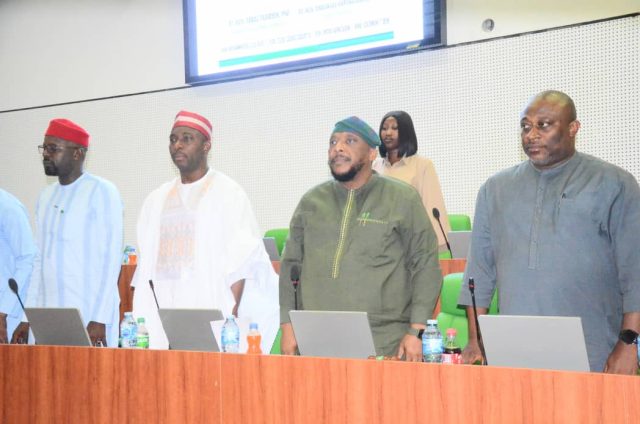
The concerns were aired on Monday at a public hearing organised by joint committees of the House of Representatives on digital and electronic banking, banking regulations, science and technology, communications, and capital markets.
Fintech operators caution
Representatives of fintech firms cautioned that the proposed commission could duplicate functions currently carried out by the Central Bank of Nigeria (CBN) and other sector regulators.
Maxwell Loko, Vice-President for Public and Government Affairs at OPay Digital Services, said the company supports the goal of strengthening oversight but warned against creating a parallel authority that overlaps with existing institutions.
“The industry’s growth demands clarity, structure and coordinated supervision. However, the effectiveness of regulation depends not only on good intentions, but on design, structure and coordination,” Loko said.
He noted that the CBN already exercises primary authority over mobile money operators, payment service providers and digital banking platforms, while agencies such as the Nigeria Data Protection Commission and the Federal Competition and Consumer Protection Commission handle data governance and consumer protection.
“Without very precise delineation of roles, the establishment of a parallel regulator risks duplication of licensing processes, overlapping supervisory examinations, increased compliance costs and regulatory uncertainty that may discourage investment,” he added.
Loko warned that Nigeria’s fintech ecosystem “thrives on speed, clarity and predictable rules,” arguing that fragmented supervision could slow innovation. He recommended strengthening the existing framework under the CBN while formalising inter-agency coordination, suggesting a single-lead-regulator model anchored by the apex bank in line with global practice.
Concerns over dual oversight
Henry Obiekea, Managing Director of FairMoney Microfinance Bank, echoed similar concerns, particularly for tech-enabled lenders.
He explained that under the proposed framework, the CBN would continue to regulate prudential and monetary issues for microfinance banks, while the new commission would supervise consumer-facing digital lending conduct.
“This creates a situation where the CBN determines what a bank can charge, while another regulator oversees how those charges are communicated and justified to consumers,” Obiekea said, describing it as regulatory duplication that could complicate compliance.
He added that services such as digital loan applications, electronic know-your-customer (KYC) processes and mobile channels might require additional licensing or registration.
However, Obiekea described the bill as both a challenge and an opportunity, noting that while it could increase compliance complexity, the formal recognition of digital finance as a distinct sector might boost investor confidence and consumer trust.
Industry groups back proposed commission
In contrast, industry associations largely welcomed the bill.
The Association of Telecommunications, Information, Technology, Cable Satellite Network Operators and Allied Services Employers of Nigeria (ATICEN) said the absence of an independent fintech regulator has resulted in fragmented and inconsistent oversight.
Adede Williams, ATICEN president, said Nigeria hosts nearly 400 fintech firms, yet lacks a statutory body dedicated to overseeing the sector.
“The absence of an independent regulatory body is a threat to consumers, investors, industry service providers and the digital economic stability at large,” Williams said, arguing that a unified authority would reduce policy overlap and provide regulatory certainty for innovation.
Similarly, Obioha Otti, Acting President of the Association of Mobile Money and Bank Agents in Nigeria (AMBAN), endorsed the bill, saying he represents over two million point-of-sale (POS) and mobile money agents nationwide.
Describing agents as the “last mile” of Nigeria’s digital financial system, Otti urged lawmakers to formally integrate AMBAN members into the new regulatory framework, especially as they serve rural and underserved communities where traditional banks have limited reach.
Lawmakers defend bill
Sponsor of the bill, Rep. Fuad Laguda, said the lack of a single coordinating authority had created fragmented frameworks that threaten investor and consumer confidence.
“Currently, Nigerian fintechs interface with multiple regulators. With the creation of the NFRC, stakeholders will have a one-stop regulatory body, enabling ease of doing business,” he said.
Laguda cited industry data showing that Nigeria’s fintech sector has attracted hundreds of millions of dollars in investment and now hosts firms with multi-billion-dollar valuations. He added that countries such as Sweden, Norway, Japan and Denmark operate independent fintech regulators alongside central banks, arguing that Nigeria could adapt similar models.
Chairman of the House Committee on Digital and Electronic Banking, Emmanuel Ukpong-Udo, described fintech as “a central pillar of financial inclusion, youth entrepreneurship and economic competitiveness,” but acknowledged that rapid growth has exposed regulatory gaps.
“HB 2389 seeks to address these challenges in a structured and comprehensive manner,” he said, stressing that the bill must be harmonised with existing laws to avoid duplication and unnecessary burdens.
Declaring the hearing open, Speaker of the House, Abbas Tajudeen, said the proposed law aims to make fintech regulation coherent, enforceable and constitutionally aligned.
He noted that fintech has driven financial inclusion, youth employment and investment, but warned that regulation has struggled to keep pace with innovation.
“The absence of a single coordinated framework has resulted in duplication and regulatory uncertainty,” Abbas said, adding that the proposed commission would complement—not replace—existing regulators such as the CBN and the Securities and Exchange Commission.
According to him, stakeholder engagement remains critical to ensuring that any new framework strengthens innovation while protecting consumers and investors in Nigeria’s expanding digital finance ecosystem.