
The Minister of Justice and Attorney General of the Federation and Civil Society Organisation (CSO) have disagreed over a bill seeking to recognise and protect human rights defenders
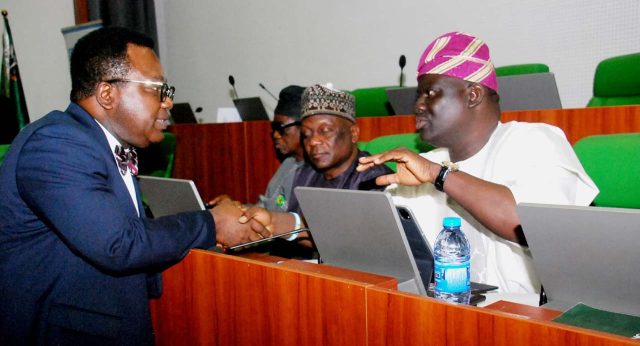
The Minister of Justice and Attorney General of the Federation, Prince Lateef Fagbemi (SAN) has disagreed with Civil Society Organisations (CSOs) over the Human Rights Defenders Protection Bill (HB 1867).
He described the bill as unnecessary and duplicative of existing laws, while raising specific concerns over provisions in a separate bill seeking to repeal and reenact the National Human Rights Commission Act.
The submissions were made on Wednesday, March 4, 2026, at a public hearing held at the National Assembly Complex, Abuja, by the House of Representatives Committee on Human Rights.
The hearing was convened to consider two bills:
- HB 1867: A Bill to Establish, Recognize and Protect Human Rights Defenders; and
- HB 2376: A bill for an act to repeal the National Human Rights Commission Act, Cap N46, Laws of the Federation of Nigeria, 2004, and the National Human Rights Commission Amendment Act, 2010; to enact the National Human Rights Commission Bill, 2025, and for related matters.
The amendment is to strengthen the day-to-day powers of the commission, to conduct investigations, and sustain contributions to the Human Rights Fund for human rights activities in the country, in line with the Paris Principles and for related matters.
The Human Rights Defenders Protection Bill seeks to play a vital role in promoting accountability, transparency, social justice, and the rule of law.
It seeks to protect civil society actors, journalists, lawyers, community leaders, whistleblowers, faith-based actors, and citizens who peacefully advocate for the protection of constitutional and internationally and preserve their recognised rights.
Representing the AGF and the Federal Ministry of Justice, Imarha Oghenenyerowo Rueben, Chief State Counsel, said while the ministry supports efforts to harmonise Nigeria’s human rights laws, it could not endorse the Human Rights Defenders Bill in its current form.
“This ministry is of the view that the bill, though well-intentioned, is legally unnecessary and evocative of existing legislative frameworks,” Rueben said.
“The real gap does not lie in the absence of legislation, but in enforcement effectiveness.”
AGF’s Objection to HB 1867
According to the Ministry of Justice, Nigeria already has an “extensive legal and institutional framework” protecting fundamental rights, including provisions under Chapter IV of the Constitution, the National Human Rights Commission (NHRC) Act of 1995, and its 2010 Amendment.
Rueben warned that passing HB 1867 could lead to regulatory overlap and institutional confusion.
“Rather than enacting duplicative legislation, the National Assembly should prioritise strengthening institutional capacity, accountability mechanisms, and implementation of existing laws,” he added.
He concluded that the ministry does not support HB 1867, while commending the lawmakers for initiating discussions around the protection of civic space.
Conditional Support for NHRC Bill
On HB 2376, which seeks to repeal and reenact the NHRC Act, the AGF expressed conditional support, acknowledging the need to harmonise multiple laws currently governing the commission.
“There is a long-standing legislative misalignment between the 1995 Act and the 2010 Amendment, which did not expressly repeal or amend the earlier law,” Rueben noted.
However, the ministry raised concerns over provisions that could undermine ease of doing business and fiscal discipline. These include:
- A proposed mandatory annual business and human rights compliance certificate for companies;
- Provisions allowing the commission to borrow funds without external oversight;
- A proposed 0.3 percent levy on the annual profits of certain companies, which the ministry said conflicts with Nigeria’s existing tax regime.
“These provisions should be reviewed and harmonised with the Nigerian tax framework and established financial oversight practices,” Rueben said.
NHRC Defends Expanded Mandate
The Executive Secretary of the National Human Rights Commission, Dr. Tony Ojukwu, defended the proposed amendments, describing them as necessary to meet Nigeria’s international obligations and improve institutional effectiveness.
He cited recommendations by the Global Alliance of National Human Rights Institutions and Nigeria’s obligations under the Optional Protocol to the Convention Against Torture (OPCAT), which requires the designation of a National Preventive Mechanism.
“The President has already designated the commission as Nigeria’s National Preventive Mechanism. We need to reflect that reality in the law,” Ojukwu said.
He also stressed the importance of activating the Human Rights Fund, first provided for in 2010 but never operationalised.
“Human rights emergencies cannot be predicted. Without a flexible funding mechanism, the commission’s hands are tied,” he said, recounting instances where NHRC staff personally assisted victims who lacked transport fare or medical care.
Civil Society Backs Rights Defenders Bill
Speaking in support of HB 1867, Dr. Jude Ohanele, Programme Director at Development Dynamics, argued that the bill would give legal recognition and protection to ordinary Nigerians who defend rights at the grassroots.
“Human rights defenders are not just activists. They are market women, journalists, fishermen, transport workers—people who insist that rights are respected,” he said.
According to Ohanele, the bill would strengthen democracy, improve Nigeria’s international image, enhance investor confidence, and provide lawful channels for civic engagement.
“Protecting human rights defenders is not an adversarial act. It is a reinforcement of constitutional order,” he added.
Committee Chair Pushes Back
Chairman of the House Committee on Human Rights, Abiola Makinde, openly criticised the AGF’s outright rejection of HB 1867.
“The Attorney-General should have pointed out both the merits and the demerits of the bill instead of a blanket rejection,” Rep. Makinde said, urging contributors to be constructive.
NBA Calls for Refinement, Not Rejection
The Nigerian Bar Association (NBA) also weighed in, supporting both bills in principle but recommending technical refinements to ensure constitutional alignment, fiscal clarity, and enforceability.
Represented by Mercy Agada, the NBA described the Human Rights Defenders Bill as “bold and progressive,” while cautioning that issues around scope, funding, and safeguards must be clearly defined.
“With careful refinement, this bill has the potential to become a landmark statute in Nigeria’s human rights framework,” the NBA said.
The committee is expected to collate submissions from stakeholders as it considers amendments to both bills before further legislative action.
In his remarks, the Executive Director, Policy and Legal Advocacy Centre (PLAC) Mr Clement Nwakwo commended National Human Rights Commission for the work so far done.
He said that there is still much to be done hence, the need for the amendment, urging the National Assembly grant all the request of the commission and pass the bill into law before August