
Ahead of the 2027 general elections, the G100 political movement and the Minority Caucus of the House of Representatives have stepped up consultations aimed at uniting opposition parties and political actors on a common platform to challenge the ruling All Progressives Congress (APC).
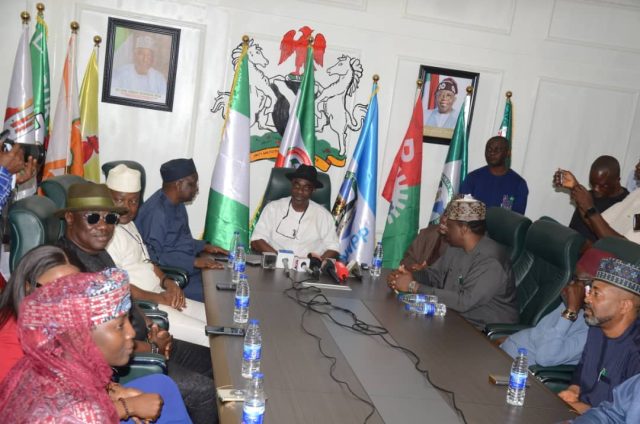
Ahead of the 2027 general elections, the G100 political movement and the Minority Caucus of the House of Representatives have stepped up consultations aimed at uniting opposition parties and political actors on a common platform to challenge the ruling All Progressives Congress (APC).
The latest development followed a meeting between a G100 delegation led by its Convener, Salihu Lukman, and the House Minority Caucus, headed by Minority Leader Rep. Fred Agbedi, at the National Assembly Complex in Abuja on Tuesday.
The meeting formed part of the G100’s consultations with opposition leaders and stakeholders ahead of its proposed Summit of Opposition Political Parties scheduled for August 31.
The renewed push for opposition unity comes amid concerns that continued divisions among opposition parties could weaken their prospects in the 2027 elections. The 2023 presidential election, when major opposition parties contested separately, has been cited by advocates of a coalition as evidence of the consequences of a fragmented opposition.
Speaking after the meeting, Agbedi described the engagement as successful, saying it marked the formal consolidation of the partnership between the G100 and the Minority Caucus.
“We had just had a successful meeting and in the meeting we concluded that this is the consummation of the alliance partnership, working together of the Minority Caucus of the House of Representatives and the G100, fusing into one to ensure that we play an active role in enriching democracy in Nigeria,” he said.
The Minority Leader urged opposition parties, leaders and presidential aspirants to set aside personal ambitions and begin negotiations towards a common political arrangement capable of mounting a strong challenge to the APC.
He argued that the economic and social difficulties confronting Nigerians had made opposition cooperation more urgent, warning that political differences should not undermine efforts to provide an alternative government.
“We also decided that we use this opportunity to call on all opposition stakeholders, particularly the leaders of the various parties and presidential candidates, to begin to develop the attitude of working together,” Agbedi said.
He added, “I want to call on all members of opposition, no matter the party you belong, no matter your ambition, that there is strength in unity and that the opposition should unite to ensure that we wrestle power from the APC in 2027.”
G100 seeks common opposition platform
Earlier, Lukman, a former APC National Vice Chairman, said the G100 initiative was established out of concern over the country’s political direction and the failure of opposition forces to coordinate effectively.
He said the movement was focused on persuading opposition parties and political actors to negotiate a common arrangement ahead of 2027 rather than promoting the interests of any particular individual or political organisation.
“Our mission is simple. It was a follow-up to the open letter we issued to our leaders, which you are part of that leadership, and we all came together out of concern,” Lukman said.
He warned that continued fragmentation among opposition parties could result in a repeat of the 2023 presidential election.
“As opposition parties, we seem to be fragmented, and if we continue the way we are going, we are almost going to replay the 2023 scenario. It is almost like a case of handing over victory to the ruling party, and then we go back to square one,” he said.
Lukman said the political and socio-economic challenges facing Nigeria required opposition leaders to put aside personal and partisan interests and negotiate a common objective.
He disclosed that the G100 had already consulted political leaders across six opposition parties as part of its efforts to build support for a possible alliance.
The parties include the African Democratic Congress (ADC), New Nigeria People’s Party (NNPP), Peoples Democratic Party (PDP), Action Peoples Movement (APM), Peoples Redemption Party (PRP) and Social Democratic Party (SDP).
According to Lukman, the consultations involved presidential candidates, running mates and national chairmen of the parties.
He said the responses had been largely encouraging, prompting the movement to plan a broader summit where the proposed coalition could be discussed in greater detail.
The summit, originally scheduled for August 18, was moved to August 31 following appeals from political leaders expected to participate in a peace accord facilitated by the National Peace Committee.
Lukman said the postponement had also provided additional time to expand consultations and bring more political actors and Nigerians into the process.
“Many Nigerians have indicated good support, and we want to work with everybody. This is not about us; it’s about the country,” he said.
He urged political leaders who had expressed support for the initiative to work with their respective parties towards negotiating a united opposition front.
Lukman also disclosed that a technical committee had been constituted to develop the framework and modalities for the proposed collaboration.
He said the Minority Caucus had agreed to nominate lawmakers to serve on the committee and participate in the ongoing negotiations.
According to him, the G100, which initially began with about 100 members, had grown beyond its original membership.
“It is an organic initiative. We want to ensure that everybody who believes they have a role to play can contribute,” he said.
Minority Caucus backs consultations
Agbedi said the House Minority Caucus was already consulting with opposition parties, presidential candidates and other political stakeholders as part of efforts to build a stronger opposition ahead of 2027.
He said several lawmakers had remained in Abuja during the legislative recess to participate in the consultations because of the importance attached to building a coordinated opposition.
“As minorities, that was our objective, and because of that, a number of us haven’t travelled since we went on vacation because we decided that we must go around all the parties and the presidential candidates and the other members to make sure that we come together and create a strong and virile opposition for the 2027 election,” Agbedi said.
He said the G100 initiative was consistent with the position of the Minority Caucus and therefore offered an opportunity for both groups to coordinate their efforts.
“When we saw the G100, it matches our position. And so this is a marriage of convenience, and we believe that we are keyed in already individually and collectively as opposition parties in the House of Representatives,” he said.
Agbedi assured the delegation that the caucus would work with the G100 collectively and through individual lawmakers.
He also confirmed that the caucus had nominated members to serve on the technical committee responsible for developing the framework for the proposed opposition alliance.
Osun election cited as opposition boost
Agbedi also described the August 15, 2026 Osun State governorship election as a boost for opposition politics, commending voters in the state for exercising their franchise.
He said the outcome demonstrated the ability of voters to influence electoral outcomes when they remained determined to protect their votes.
“You see it as a victory for the opposition. First, the congratulations go to the people of Osun State. Without the determination of the people, be it INEC or whoever, we wouldn’t have had democracy saved in Osun State,” he said.
He urged Nigerians to emulate what he described as the determination of Osun voters and resist attempts to compromise their choices during elections.
Agbedi, however, said the election should not be interpreted as an unqualified endorsement of the Independent National Electoral Commission (INEC), noting that the exercise was not perfect.
“Whether INEC has proved herself or not, I don’t think that the election was 100 per cent. And so we are not here to begin to say that INEC has done well,” he said.