
The Minister of Education has sought legislative backing to allocate at least 20 per cent of the budget to education, in line with UNESCO’s recommendation
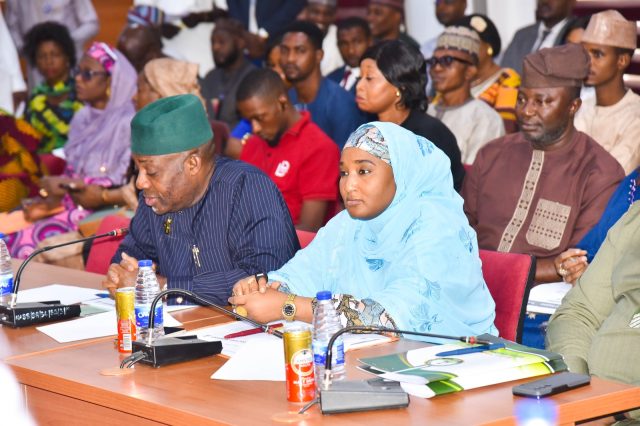
The Minister of Education, Tunji Alausa, has appealed to the National Assembly to give robust backing to the Federal Ministry of Education’s 2026 budget, warning that chronic teacher shortages, weak school security and decaying infrastructure are undermining learning outcomes nationwide.
Parliament Reports recalls that out of the N58.47 trillion 2026 appropriation proposal by the Federal Government before the NationalAssembly, education sector is expected to gulp N3.53 trillion which is about 6 percent of the total budget.
Alausa made the call while defending the ministry’s 2026 budget proposal before the Senate and House of Representatives joint committee on education at the National Assembly.
He assured lawmakers that once approved, the budget would be prudently implemented to deliver measurable improvements that reflect the impact of sustained investment in the education sector.
“We are seeking to persuade the National Assembly that a minimum of 20 per cent allocation to education, as recommended by UNESCO, should become the benchmark for future budgets,” the minister said. “Education is the backbone of national development. Without adequate funding, our schools cannot equip learners with the skills needed to compete globally in the 21st century.”
On staffing, Alausa disclosed that Federal Unity Colleges are facing a shortfall of more than 3,500 teachers, a gap he said is severely affecting the teaching of core subjects such as science, mathematics and technical courses.
“The shortage of qualified teachers is crippling our efforts to deliver quality education and produce globally competitive graduates,” he said, calling for immediate funding to recruit, train and retain skilled educators.
The minister also raised concerns about insecurity in schools, particularly in areas prone to kidnapping, banditry and armed robbery. He noted that many schools are unfenced and lack stable electricity, limiting the deployment of modern security infrastructure.
“Our children must learn in safe environments. Security is non-negotiable, and adequate funding is required to install surveillance systems, build perimeter fencing and implement other protective measures,” Alausa stated.
ALSO READ: Tax reforms: Revenue Service targets ₦40.7trn for 2026
He further highlighted acute infrastructure deficits, including shortages of classrooms, hostels, laboratories and libraries, warning that overcrowding, obsolete equipment and poorly stocked libraries are constraining practical learning and research.
Low levels of ICT integration in schools were also flagged, with the minister urging major investments in computers, internet connectivity and digital learning tools to modernise teaching and prepare students for a knowledge-driven global economy.
In addition, Alausa proposed the establishment of a dedicated, ring-fenced scholarship account to ensure timely and full disbursement of funds, especially for international awardees. He recommended that foreign payments be made in local currencies or US dollars to shield beneficiaries from exchange rate volatility.
“Many scholarship beneficiaries are indigent but high-performing students. Inadequate funding exposes them to hardship and limits their potential,” he said.
The minister explained that the 2026 budget aligns with President Bola Tinubu’s eight priority areas, the education sector roadmap and the renewed hope agenda. He outlined the ministry’s key focus areas to include reintegrating out-of-school children, ensuring safe learning environments, strengthening teacher capacity and improving tertiary institutions to produce a skilled workforce.
“The 2026 budget is not just a financial plan; it is a blueprint for transforming Nigeria’s education system,” Alausa said, urging lawmakers to prioritise education as a national imperative and support the proposal in the interest of the country’s future.