The House Committee on Insurance and Actuarial Matters has praised the NDIC over 97 percent budget implementation in 2025
The Nigeria Deposit Insurance Corporation (NDIC) has achieved a 97 per cent implementation of its 2025 budget, a performance lawmakers say outpaces many other Ministries, Departments and Agencies (MDAs), particularly on capital expenditure.
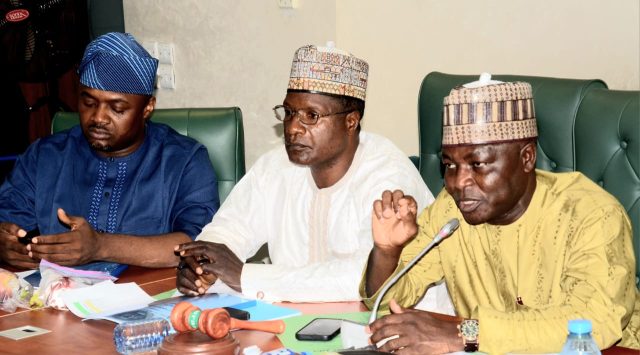
The Chairman of the House of Representatives Committee on Insurance and Actuarial Matters, Rep. Ahmed Jaha, made the observation on Thursday during a budget defence session, following the presentation of NDIC’s 2025 budget performance and its proposed 2026 estimates by the Managing Director/Chief Executive, Thompson Oludare Sunday.
Commending the corporation’s fiscal discipline and prudent resource management, Rep. Jaha described the 97 per cent execution rate as “remarkable,” noting that several MDAs recorded minimal or even zero implementation, especially in their capital components.
“I want to put this on record that NDIC is one of the agencies operating strictly under the Fiscal Responsibility framework on cost-to-income ratio,” he said. “Fifty per cent of its generated income is remitted to a dedicated Consolidated Revenue Fund account of the Federal Government, while the remaining 50 per cent is retained to run the agency.
“Despite this limitation, NDIC has achieved nearly 97 per cent budget implementation for 2025. Meanwhile, some agencies recorded zero per cent performance, particularly on their capital components. This success is because NDIC is a self-generating, government-owned enterprise that manages its revenue efficiently within the fiscal responsibility guidelines.”
Earlier, Mr. Sunday presented a proposed total budget of ₦589.89 billion for the 2026 fiscal year, explaining that it represents an increase of ₦151.22 billion over the 2025 budget.
He said projected total expenditure for 2026 stands at ₦250.46 billion, equivalent to 50 per cent of the corporation’s projected income, in line with the cost-to-income ratio policy. NDIC also projected a surplus of ₦254.74 billion for 2026, of which 50 per cent—about ₦252.60 billion —will be remitted to the Federal Government as required by law.
According to him, the projections were designed to ensure regulatory stability, operational efficiency and sustained protection of depositors in Nigeria’s financial system.
Meanwhile, the Commissioner for Insurance at the National Insurance Commission (NAICOM), Olusegun Omosehin, presented a proposed ₦25.667 billion expenditure for 2026, with projected net revenue of ₦25.702 billion.
Omosehin told the committee that NAICOM’s Internally Generated Revenue (IGR) is expected to rise to ₦34.270 billion in 2026—an increase of ₦4.348 billion from the ₦29.921 billion projected for 2025—representing a 14 per cent growth. He attributed the increase to new revenue-enhancing initiatives and tighter controls to curb leakages.
He also commended the National Assembly for its support in passing the Nigerian Insurance Industry Reform Act, recently signed into law by President Bola Tinubu.
On sector reforms, Omosehin disclosed that NAICOM has commenced the recapitalisation of insurance firms as the first phase of a broader restructuring agenda.
“The goal is to reform, rebuild and recapitalise the sector. We are committed to a transparent process,” he said, adding that the exercise will conclude on July 31, 2026, after which only companies that meet the new minimum capital requirements will continue operations.