
The security and intelligence committee has faulted the 2026 budget, saying the intelligence sub-sector is poorly funded and falls short of the vision painted by President Tinubu
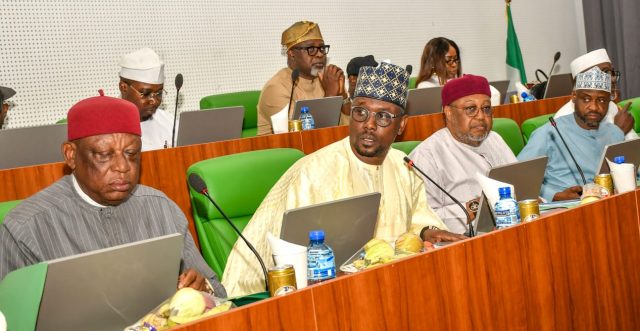
Chairman of the House of Representatives Committee on National Security and Intelligence, Rep. Ahmad Satomi, has decried what he described as abysmal funding for Nigeria’s intelligence sub-sector in the 2026 budget proposal.
He urged President Bola Tinubu to urgently prioritise and enhance funding for intelligence and security agencies.
Speaking during a budget defence session on Wednesday, Satomi said the allocations to the intelligence community did not reflect the president’s stated commitment to resetting Nigeria’s national security architecture.
“I am also happy that Mr. President in his speech acknowledged the relevance of the intelligence subsector in the overall drive for a stable national security. In the 2026 budget speech, he said, ‘Our administration is resetting the national security architecture and establishing a new national counterterrorism doctrine — a holistic redesign anchored on unified command, intelligence gathering, community stability, and counter–insurgency. This new doctrine will fundamentally change how we confront terrorism and other violent crimes,’” he said.
However, Satomi expressed concern that the figures in the 2026 budget proposal contradicted that vision.
“Looking at the 2026 budget proposal, the defence and security sector is allocated N5.41 trillion. The intelligence subsector comprising the Office of the NSA and its agencies, the Department of State Services, the National Intelligence Agency, Presidential Air Fleet and the National Institute for Security Studies is allocated a total of N664,119,740 for their personnel, overhead and capital expenditures in 2026,” he said.
He further provided a breakdown of the allocations, noting that personnel cost for intelligence agencies stood at N245,941,663,329, overhead costs at N131,273,507,85, while capital expenditure was put at N286,904,549,354.
“These allocations are indeed very abysmal and do not seem to match the intent of the speech delivered by the president to the Joint Session of the National Assembly on December 19, 2025,” Rep. Satomi added.
The committee chairman also faulted the implementation of the 2025 budget, saying releases to the security and intelligence sector showed little evidence of prioritisation.
“There is absolutely nothing to suggest that the presidency prioritises security and intelligence if we go by the releases for the 2025 budget implementation, at the least the releases that are known to us. One would have expected that if indeed the provision of welfare and security is the primary purpose of governance, then releases to the security sector should not be treated trivially,” he said.
Satomi therefore appealed directly to the president to intervene. “This committee is making a passionate appeal to our dear president to please look into the funding of the agencies in the intelligence sector, enhance them and prioritise them,” he said.
ALSO READ: Lawmakers fume over zero fund release to interior ministry
Earlier, the Permanent Secretary, Special Services, Office of the National Security Adviser (ONSA), Mohammed Sanusi, had appealed for a supplementary budget to enable the intelligence community to respond more swiftly to national security challenges.
Sanusi said the request had become more urgent following the recent declaration of a state of emergency on national security, stressing that “no nation can grow without adequate security.”
He explained that the budget defence covered the Office of the National Security Adviser and its centres, including the National Counter Terrorism Centre, National Cybersecurity Coordination Centre, National Centre for the Control of Small Arms and Light Weapons, and the Presidential Amnesty Programme, as well as agencies such as the Department of State Services, National Intelligence Agency, National Institute for Security Studies and the Presidential Air Fleet.
According to Sanusi, priority areas for 2026 include combating terrorism, banditry and kidnapping; securing critical infrastructure; protecting oil and gas facilities; enhancing cybersecurity; addressing transnational crimes and the proliferation of small arms across the West African corridor; and managing the security implications of political instability in neighbouring countries.
He also outlined challenges affecting budget implementation, including the envelope system of budgeting, irregular release of overhead costs, non-release of capital allocations, high exchange rates, inadequate operational vehicles, and the high cost of maintaining the Presidential Air Fleet abroad.
“I wish to state and reiterate to the Distinguished Members that the Intelligence Community always assured this Committee and the entire National Assembly of its commitment to transparency, accountability and effective resource management,” Sanusi said.
Satomi, in his concluding remarks, warned that resistance by security agencies to legislative oversight was counterproductive, stressing that oversight “does not mean antagonism, hostility or witch hunts.”
“Oversight helps to get the Nigerian people to participate in security governance through their elected representatives. This engenders trust, transparency, accountability and value for money,” he said, while assuring that the House of Representatives remains committed to supporting intelligence agencies to achieve a safe and secure Nigeria.