
Senate passes electoral bill retaining controversial provision allowing transmission of results in a manner prescribed by INEC
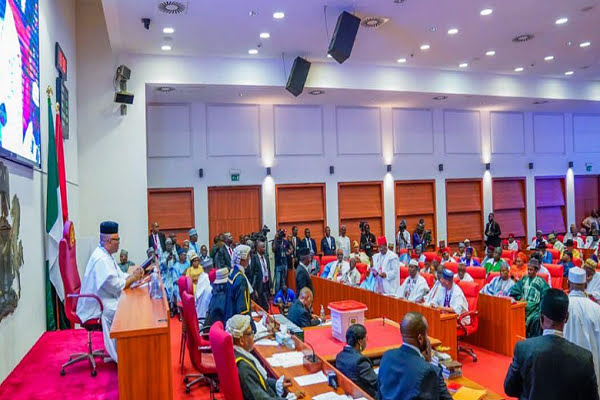
The long-anticipated approval of the Electoral Act Amendment Bill was granted on Wednesday, with the Senate passing the legislation after hours of intense debate.
The Senate rejected a proposal to make real-time electronic transmission of election results mandatory, but approved wide-ranging amendments that significantly alter election timelines, penalties for electoral offences and voter accreditation procedures.
A major point of contention during deliberations was Section 60 of the bill, which governs the transmission of election results.
Lawmakers voted down a recommendation by the Senate Committee on Electoral Matters seeking to compel presiding officers to upload polling unit results to the Independent National Electoral Commission’s (INEC) Result Viewing Portal (IREV) “in real time.”
Instead, the red chamber retained the provision in the 2022 Electoral Act, which allows electronic transmission of results in a manner prescribed by INEC after votes have been counted and announced at the polling unit.
Under the retained provision, presiding officers are required to count votes at the polling unit, record the results on prescribed forms, announce them publicly, and transmit the results electronically to the appropriate collation centre as directed by INEC. Copies of the result forms must also be issued to polling agents and security personnel where available.
Any presiding officer who wilfully contravenes the provision is liable on conviction to a fine not exceeding N500,000 or imprisonment for a minimum of six months.
The rejected amendment would have gone further by expressly mandating immediate, real-time upload of results to the IREV portal after the signing of Form EC8A, with stiffer penalties attached.
Senators who opposed the proposal argued that the phrase “real time” could pose practical challenges, particularly in areas with poor or non-existent network coverage, and could expose elections to avoidable legal disputes.
Chairman of the Senate Committee on Media and Public Affairs, Senator Adeyemi Adaramodu, said the disagreement was largely semantic rather than substantive.
He stressed that electronic transmission of results had not been removed from the bill, noting that results would still be made publicly available electronically alongside physical result forms.
According to him, both electronic and manual records would continue to serve as corroborative evidence in the event of election disputes.
Beyond the controversy over result transmission, the Senate approved far-reaching changes to Nigeria’s electoral calendar.
Lawmakers reduced the election notice period from 360 days to 180 days before the expiration of the tenure of the current administration. The deadline for political parties to submit their lists of candidates was shortened from 120 days to 90 days, while the deadline for candidate nomination was cut from 180 days to 90 days.
In a move aimed at strengthening deterrence against electoral malpractice, the Senate increased the fine for unlawful possession of voters’ cards from N500,000 to N5 million.
However, it rejected a proposal to impose a 10-year ban on individuals convicted of vote buying from participating in political activities, opting instead for stiffer financial penalties.
The lawmakers also formally removed the smart card reader from the electoral framework and replaced it with the Bimodal Voter Accreditation System (BVAS), while retaining provisions for electronic transmission of results.
Other amendments clarified the consequences of candidate disqualification, particularly in cases involving forged or fake documents. Under the new provisions, political parties will no longer be allowed to replace candidates disqualified after an election. Where necessary, fresh polls will be conducted excluding both the disqualified candidate and the sponsoring party.