
The DG NADDC, Joseph Osanipin, has called for the transformation of Nigeria’s automotive development policy into law
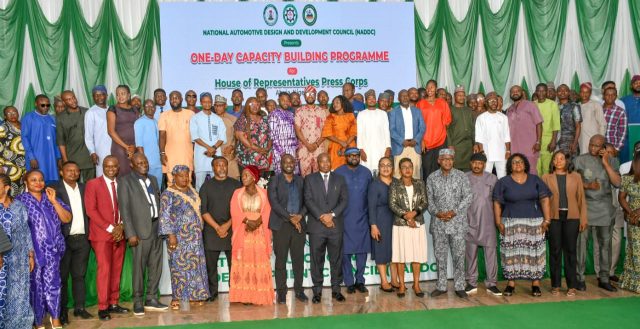
The Director General of the National Automotive Design and Development Council (NADDC), Otunba Joseph Osanipin, has called for Nigeria’s automotive policy to be transformed into law, warning that investors will remain cautious without clear legislative backing.
Osanipin made the call in Abuja at a capacity-building workshop for members of the House of Representatives Press Corps, organised by the NADDC in collaboration with the House Committee on Media and Public Affairs.
The workshop was themed “Strengthening Sectoral Policy Communication and Legislative Reporting on Nigeria’s Automotive Industry Development.”
According to him, while the Nigeria Automotive Industry Development Plan provides direction for the sector, long-term industrial growth requires legal certainty.
“Investors looking at large-scale vehicle assembly and component production need assurance that policy incentives will endure beyond administrative cycles,” Osanipin said. “Without legislative backing, the industry remains vulnerable to policy reversals.”
He described the automotive industry as one of the most capital-intensive sectors globally, stressing that sustained policy consistency is critical before investors commit significant resources.
“Transforming the automotive policy into law will provide stability, deepen local production and accelerate industrialisation,” he added.
Osanipin disclosed that the Council plans to intensify engagement with lawmakers at the National Assembly to strengthen the legal foundation of Nigeria’s automotive development framework. He also urged journalists covering legislative and economic issues to situate policy decisions within their broader industrial context, particularly measures designed to protect domestic production.
Drawing comparisons with global trade practices, he noted that many countries adopt protective policies to nurture local industries, build technological capacity and create jobs.
“These measures are not unusual. They are designed to drive technology transfer, employment and long-term economic resilience,” he said.
Highlighting progress in local innovation, Osanipin revealed that Nigeria has successfully designed and produced tricycles using locally sourced materials and is building capacity in compressed natural gas (CNG) vehicle assembly. He added that more than 15,000 technicians have been trained nationwide to strengthen after-sales services and technical sustainability in the sector.
Nigeria, he said, currently spends trillions of naira annually on vehicle and spare parts imports — a trend the Council aims to reverse through localisation programmes targeting selected automotive components.
“No country produces every vehicle component, but Nigeria has identified parts we can manufacture locally and we are working with assemblers to expand that capacity,” he explained.
Osanipin further disclosed that global manufacturers such as Toyota, Volkswagen and Ford have inspected facilities in Nigeria and expressed surprise at the level of infrastructure available.
“Some of the production equipment here ranks among the most sophisticated on the continent, yet receives limited visibility in public discourse,” he said.
Linking automotive development to broader economic goals, the NADDC boss said the sector supports industrial diversification, conserves foreign exchange and positions Nigeria to benefit from continental trade under the African Continental Free Trade Area through stronger local content.
He expressed confidence that improved policy communication and informed legislative reporting would strengthen Nigeria’s push to expand its automotive footprint across Africa.
Speaking at the event, the Chairman of the House Committee on Media and Public Affairs, Rep. Akin Rotimi Jr., underscored the need for specialised knowledge among legislative reporters, describing informed media coverage as essential to translating industrial policy into public understanding.
“Legislative work does not end with lawmaking or oversight. It is completed when policies are clearly understood by citizens,” Rep. Rotimi said.
He conveyed the goodwill of the Speaker of the House of Representatives, Tajudeen Abbas, and members of the 10th Assembly, describing the programme as part of broader institutional reforms aimed at improving policy communication and democratic accountability.
According to him, the House has institutionalised a structured and continuous capacity development programme for its media teams to ensure legislative reporting keeps pace with increasingly complex policy issues.
“The automotive sector sits at the intersection of industrialisation, job creation, technology transfer and economic diversification,” he said, noting that the training aligns with the House legislative agenda on economic growth and diversification away from oil dependence.
Rotimi commended the NADDC for providing technical depth and institutional leadership, adding that the primary goal of the training was to improve the depth, accuracy and context of parliamentary reporting on the automotive sector.
Also speaking, the Chairman of the Nigeria Union of Journalists (NUJ), FCT Council, Grace Ike, urged legislative reporters to strengthen policy-focused journalism on the automotive industry.
“Our role as journalists is to translate complex sectoral policies into stories that resonate with everyday Nigerians,” she said.
Ike described the training as a strategic intervention to equip journalists to improve coverage of legislative and regulatory initiatives, including emerging developments in electric vehicle adoption.
Meanwhile, the Chairman of the House of Representatives Press Corps, Gboyega Onadiran, called for stronger national commitment to local automotive production, warning that Nigeria’s dependence on imported vehicles is worsening economic pressure.
“In today’s Nigeria, industrialisation is no longer optional. It is economic survival,” Onadiran said.
He identified heavy reliance on fully built imports as a major contributor to capital flight and foreign exchange pressure, noting that strengthening local production would conserve forex, create jobs and stimulate growth in supporting industries.
Onadiran cited existing assembly plants and indigenous manufacturers such as Innoson Vehicle Manufacturing as evidence of growing domestic capacity, urging Nigerians to consciously patronise locally assembled vehicles.
“When we buy locally assembled vehicles, we invest in Nigeria’s industrial future,” he said.
He emphasised the role of legislative action and responsible media reporting in driving policy success, noting that public understanding is critical to strengthening investor confidence and ensuring accountability.
According to him, Nigeria stands at an economic crossroads, and success in strategic sectors like automotive manufacturing will be critical to the country’s long-term prosperity.