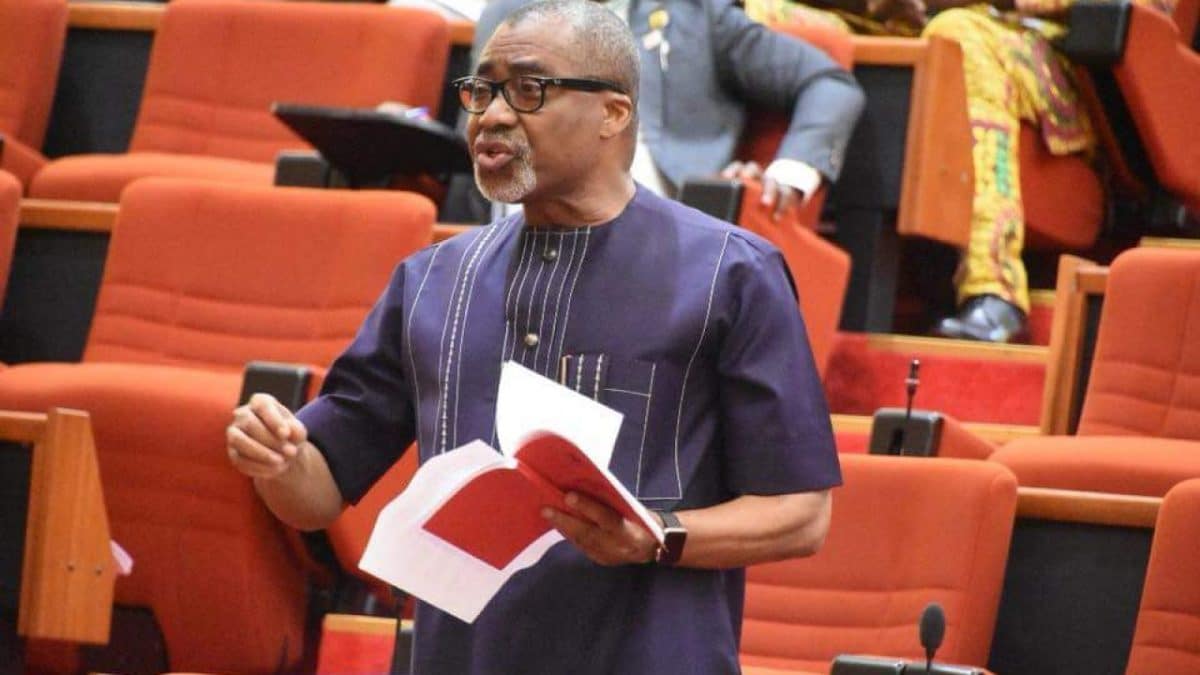
It was a heated exchange as Rep. Abiante criticised the Agric ministry’s proposals and clashed with the committee leadership over attempts to hush him
A mild altercation broke out on Tuesday during the 2026 budget defence of the Federal Ministry of Agriculture and Food Security, as a member of the House of Representatives, Rep. Awaji-Inombek Abiante, sharply criticised the ministry’s proposals and clashed with the committee leadership over attempts to limit debate.
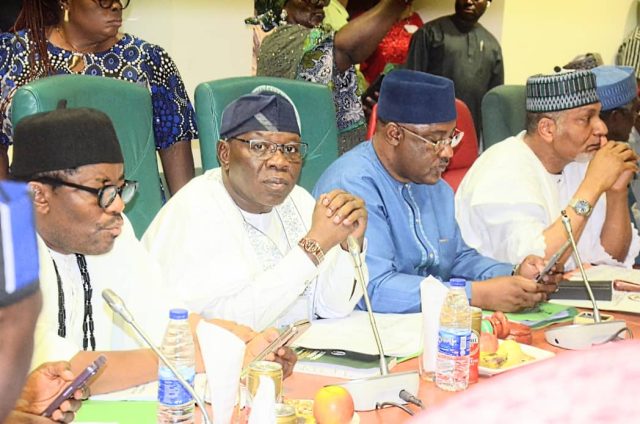
The incident occurred at a joint session of the Senate and House Committees on Agricultural Production, Services and Rural Development, where the Minister of State for Agriculture and Food Security, Sabi Abdullahi, presented the ministry’s 2026 budget estimates.
Abiante questioned the clarity, structure and fairness of the proposed programmes, arguing that several budget lines were vague and failed to meet federal character requirements or allow for effective accountability.
“Does this report conform with the requirement of federal character?” he asked. “A whole lot of what is embedded here has no appropriate description.”
As he sought to elaborate, the chairman of the committee, Rep. Bello Ka’oje (APC, Kebbi), struck the gavel in what appeared to be an effort to curtail his contribution. Mr Abiante refused to yield the floor, escalating the exchange.
“Mr Chairman, I have the floor. If you don’t want me to speak, I will get my things and go,” he said. “I was elected by my people to defend their interest, and it is that interest I have come here to defend, not yours.”
He accused the chairman of attempting to silence him for the second time during committee proceedings, warning that such conduct undermined legislative oversight.
“We don’t seem to be acting like a serious-minded people or country,” he added.
The lawmaker criticised what he described as vague and unverifiable descriptions in the budget, saying broad phrases such as “food security gross value chain development” and “implementation of manpower development strategies” were meaningless without concrete explanations.
“How do you talk about food security gross value chain development? What does it mean?” he queried. “You talk about implementation of manpower development strategies—what does that mean?”
He also faulted references to market upgrades across geopolitical zones, noting that markets fall under local government jurisdiction.
“If you say six geopolitical zones, where exactly? Which village?” he asked.
On rural infrastructure, Mr Abiante said he had never seen evidence of some of the projects cited in the budget.
“You talked about rural roads and infrastructure. I have not seen one in my life, and the chairman wanted to shut me down,” he said.
Warning lawmakers against overlooking such issues, he said failure to insist on clarity and transparency could compromise the entire budget process.
“As gatekeepers, if we fail to keep the gates, we collapse everything,” he said.
Amid the tension, Rep. David Ogewu (APC, Benue) proposed that lawmakers move into an executive session. While Mr. Abdullahi expressed willingness to address the concerns either privately or publicly, the committee chairman ruled that deliberations should continue in an open session.
Minister defends budget, cites food security emergency
Earlier in his presentation, Mr. Abdullahi said the ministry’s 2026 budget was designed to expand agricultural production, improve sustainability and stabilise Nigeria’s food system.
He said the strategy was anchored on the food security emergency declared by President Bola Tinubu in 2023, following rising inflation, supply chain disruptions and declining household access to food.
According to the minister, the declaration placed agriculture “at the centre of national economic recovery,” with emphasis on scaling output across value chains, improving mechanisation and reducing post-harvest losses.
He acknowledged that funding constraints, rising input costs and structural bottlenecks continued to weigh heavily on farmers, despite marginal increases in output recorded in recent government surveys.
To support his claims, Mr Abdullahi said the ministry had submitted an Agricultural Performance in Nigeria report covering 2024 and 2025 to the National Assembly, outlining ongoing interventions and outcomes.
On budget performance, he disclosed that while personnel costs under the 2025 appropriation were largely implemented, capital projects suffered from delayed releases. About 30 per cent of the core ministry’s capital allocation—approximately ₦18 billion—was yet to be released, while only ₦19.8 billion had been disbursed for constituency-related projects.
For 2026, he said the agricultural sector is projected to receive about ₦1 trillion, with the Federal Ministry of Agriculture and Food Security allocated approximately ₦262 billion for capital expenditure and ₦19.18 billion for recurrent spending.
Mr Abdullahi identified rising input costs—driven by fertiliser production challenges, gas pricing policies and taxation on agro-chemicals—as the most pressing issue confronting farmers.
He also revealed that more than 7,000 tractors nationwide were previously under-utilised due to poor distribution systems, a mistake he said the government was determined not to repeat. According to him, President Tinubu has approved the procurement of over 2,000 tractors, with distribution already underway and plans to train youths in operation and maintenance.
He added that the renewed hope agricultural initiative had been rebranded as the National Urban Agricultural Programme to encourage grassroots farming, while young farmers’ clubs were being promoted to boost youth participation.
Lawmakers raise funding, subsidy concerns
Contributing, Senator Adamu Aliero (APC, Kebbi Central) lamented that farmers were not receiving fair value for their produce, warning that the situation could discourage production and worsen unemployment.
“We are not doing anything in terms of subsidy. In fact, subsidy has been removed,” he said, calling for closer collaboration between the ministry and the National Assembly to address pricing distortions.
Chairman of the Senate Committee on Agriculture, Production and Rural Development, Saliu Mustapha (APC, Kwara Central), warned that declining budgetary allocations to agriculture could worsen food insecurity.
He noted that while total national expenditure is projected to rise to ₦58.47 trillion in 2026, the agriculture ministry’s allocation dropped from ₦2.22 trillion in 2025 to ₦1.45 trillion.
Similarly, Mr Ka’oje cautioned that reduced funding could undermine food security goals and slow economic recovery.
He assured that the National Assembly’s review would prioritise transparency, accountability and alignment with President Tinubu’s renewed hope agenda, stressing that agriculture remains critical to food security, employment and national stability.