
Secretary of the Presidential Working Group on the National Policing Bill, Nnadubem Moghalu, has disclosed that four states- Edo, Oyo, Osun and Rivers – have approved the constitutional amendment bill seeking to establish state police
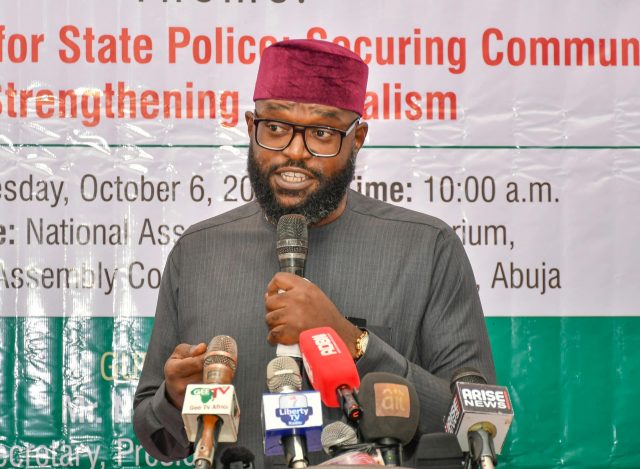
Nigerians should be able to seek police assistance without first having to contact an influential person, the Secretary of the Presidential Working Group on the National Policing Bill, Nnadubem Moghalu, has said.
Moghalu said this should be the ordinary expectation of policing in Nigeria as the country moves towards establishing state police.
“The Nigerian who needs the police at three in the morning should be able to get help without influence, without payment demanded as the price of protection, and without first becoming a national news story,” he said.
He spoke on Tuesday while delivering a lecture at the second annual House of Representatives Press Corps Distinguished Parliamentary Lecture in Abuja.
The lecture was themed, “The Imperative for State Police: Securing Communities, Strengthening Federalism.”
Moghalu said the proposed policing reforms must not simply transfer the shortcomings of the existing system to another level of government.
According to him, the success of the reform should be measured by whether citizens receive effective policing and can hold security institutions accountable.
“What I can state without reservation is the standard we must meet. First, if these reforms merely federalise the status quo, distributing familiar failures across more institutions, they will have failed,” he said.
“That would be a profound and unforgivable betrayal of a people who have already suffered too much. Success is not negotiable as the cost of failure is too great.”
He said the reform must also provide police officers with adequate training, equipment, institutional support and welfare, while ensuring that misconduct attracts consequences.
“Professional policing requires proper training and dependable support. An officer must be able to carry out a lawful duty with the equipment and institutional backing it requires. Welfare belongs in any serious discussion of performance. So does the expectation that misconduct will have consequences,” he said.
Moghalu stressed that legislation would only mark the beginning of a longer process, noting that effective policing would require sustained funding, administrative discipline and a functioning justice system.
He said citizens would ultimately judge the new system by their experiences, including whether police reports receive attention, investigations are competently handled and complaints of abuse result in action.
Four states approve amendment
Moghalu disclosed that four states- Edo, Oyo, Osun and Rivers- have so far approved the constitutional amendment bill seeking to establish state police.
He said the National Assembly had transmitted the proposed amendment to the 36 State Houses of Assembly as part of the constitutional alteration process.
“The National Assembly has sent the constitutional amendment bill to the State Houses of Assembly. They have begun considering and approving it. At the time of preparing this lecture, four states had approved the bill: Edo, Oyo, Osun and Rivers states,” he said.
He explained that at least 24 of the 36 state Houses of Assembly must approve the constitutional amendment before the process can proceed.
Moghalu, however, said constitutional approval alone would not be enough to establish an effective state policing system.
“The distinction between the constitutional amendment and the national policing bill we are now working on is very important,” he said.
“The constitutional amendment creates the constitutional basis for a dual policing model. The National Policing Bill is intended to provide the operational framework through which that constitutional model can work in practice.”
According to him, the constitutional amendment would not by itself provide for the recruitment and training of officers, establishment of police stations or development of the administrative capacity required to investigate crimes.
“Those tasks require preparation and resources, and they require time to get things done,” he said.
Police reform must address manpower gap
Moghalu also identified inadequate police manpower as one of the challenges facing Nigeria’s security system.
He said the country currently had about 380,000 police officers serving a population of more than 200 million people.
“This gives you a ratio of about one police officer to every 650 citizens. The minimum international best practice is supposed to be one to 400,” he said.
He said effective policing remained central to detecting threats early, responding to victims and ensuring that perpetrators were brought to justice.
Moghalu, however, noted that the police were not solely responsible for Nigeria’s security challenges, saying the courts, other security agencies and political authorities also had roles to play.
State police and local realities
The working group secretary said Nigeria’s security challenges differed across communities, making local knowledge important to effective policing.
“Policing a dense commercial district requires different knowledge than policing a rural transport corridor,” he said.
He said state police could bring policing closer to communities, while the federal police would retain responsibility for crimes and threats that cross state boundaries.
Moghalu acknowledged concerns that state police could be abused by governors or other political interests.
“A governor may put pressure on the police to treat a political opponent as an enemy of state,” he said, adding that local majorities could also use the police against minorities.
He said such risks must be addressed through strong institutions, clear laws, accountability mechanisms and safeguards against political interference.
“Our institutions must be designed to work, even when people who hold power are people we do not trust,” he said.
He added that Nigeria should not depend on assurances from political office holders but should establish institutions capable of surviving changes in leadership.
Moghalu urged Nigerians to scrutinise the full National Policing Bill when it is published, saying public engagement would help identify provisions that could create uncertainty or leave practical problems unresolved.
He said the Working Group’s assignment would conclude after presenting a draft validated by the group and the Ministry of Justice to the President for consideration and transmission to the National Assembly.
He said the plan was to publish the bill on the National Policing Bill website: nationalpolicingbill.com when it was transmitted to the National Assembly and invite Nigerians to examine the complete text.
Moghalu also stressed that the drafting process did not pre-empt the constitutional responsibilities of the National Assembly.
“Parliament’s role in scrutinising this legislation remains sacrosanct,” he said.
He urged Nigerians to assess the proposed law against the practical expectations of policing, including whether citizens could obtain help when they needed it and whether they could hold security institutions accountable when they were abused.
He also called on the media to explain the difference between a proposal, a constitutional amendment and an institution that is fully operational.
Niger backs state police
The Niger State Governor, Umar Bago, represented by the APC National Vice Chairman, North-Central, Muazu Rijau, expressed support for the establishment of state police.
Rijau said the level of insecurity across the country required a security architecture capable of responding to the peculiar circumstances of individual communities.
“We in Niger State and across Africa would love to see State Police become a reality in Nigeria,” he said.
He said Niger State supported continued exploration of practical solutions to insecurity, adding that state police deserved serious consideration as part of broader security sector reforms.
Also speaking, the Minority Leader of the 9th House, Ndudi Elumelu, said the state police debate should be approached as both a security and governance issue.
He said the proposed system must address concerns around professionalism, accountability, human rights and political interference.
“A sustainable policing framework must therefore provide effective mechanisms for oversight, accountability and redress, while ensuring adequate training, welfare, funding and professional standards for personnel,” he said.
Speaker tasks media with objective reporting
In his goodwill message, Speaker of the House of Representatives, Rep. Abbas Tajudeen, represented by the Chairman of the House Committee on Media and Public Affairs, Rep. Akin Rotimi, urged journalists to assess legislation based on its provisions and likely consequences rather than the political circumstances surrounding it.
“Legislation should not be judged merely by the political circumstances in which it originates. Nor should public policy be assessed simply according to who proposes it, which party supports it, or which section of the country perceives itself to be in favour of it,” Tajudeen said.
He urged journalists to report not only what lawmakers say but also what is at stake in parliamentary decisions.
“As journalists, the public deserves reports and accounts of not only what was said, but also what is at stake,” he said.
The Speaker said the media should provide accurate, fair and contextual reports without becoming an “echo chamber for parliament”.
Earlier, the Chairman of the House of Representatives Press Corps, Gboyega Onadiran, said the choice of state police as the theme reflected the urgent security concerns facing Nigerians.
He said journalists covering the National Assembly routinely witnessed lawmakers receiving distress calls from their constituencies over terrorism, banditry, kidnapping, farmer-herder conflicts and ungoverned spaces.
Onadiran said the debate had moved beyond theory, with the central question now being whether state police could protect communities without becoming political instruments of governors.
The proposed state policing model would allow individual states to operate their own police forces alongside the Nigeria Police Force, with the aim of bringing policing closer to communities and improving responses to local security challenges.